Why an EV breaks even after 3–5 years
A 2020 Tesla Model X emits ~23 tons of CO₂ before it ever drives a mile — battery, aluminum body, electric motors, copper, and power electronics combined. That's ~2.9× a comparable BMW X5 (~8t). Depending on grid, driving, and chemistry, it takes 3–5 years to pay back that "carbon debt."
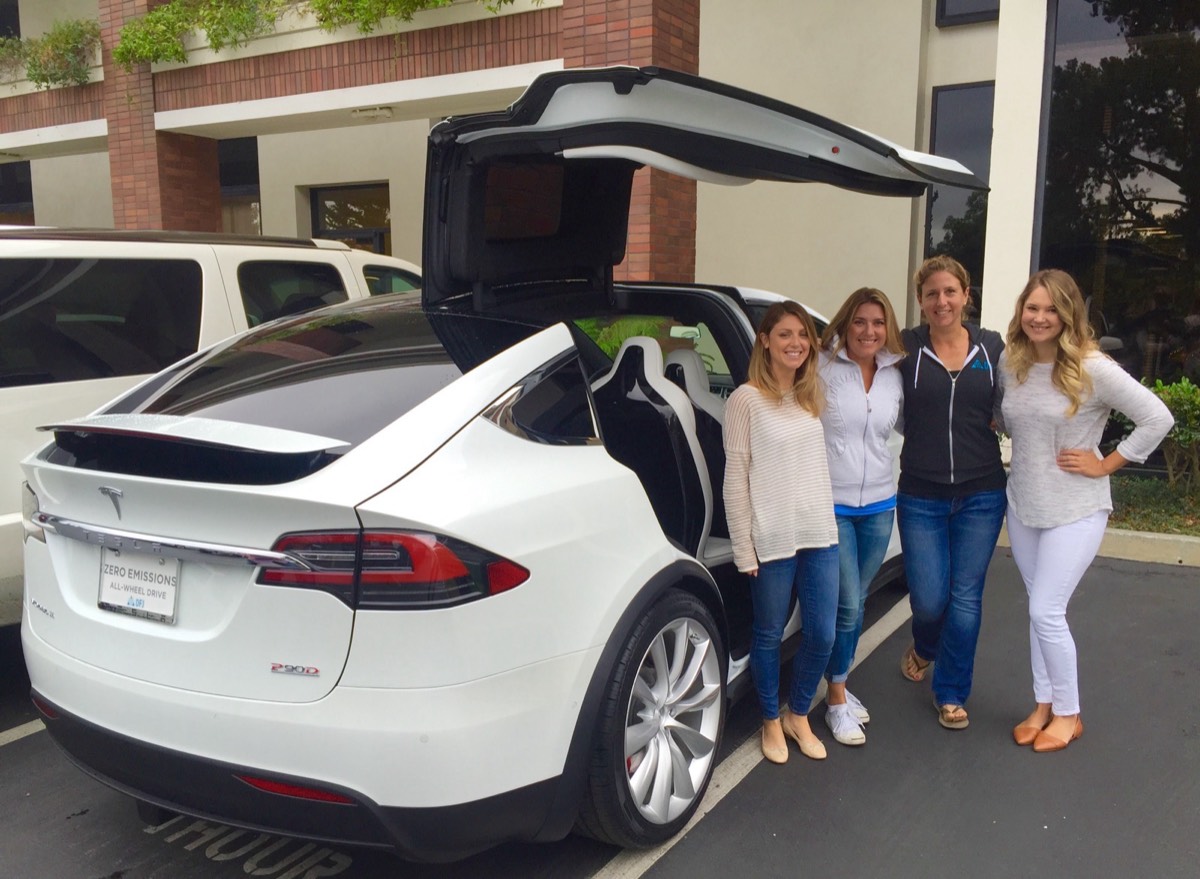
The iconic double-hinged falcon wing doors — sensor-equipped, ~80 lbs each, made from aluminum. Cool engineering, but also: more aluminum, more actuators, more carbon to build.
The iconic falcon wing doors — double-hinged, sensor-equipped, and ~80 lbs each. Cool engineering, but also: more aluminum, more actuators, more carbon to build.
Adjust what you control
The car is the car — but how, where, and how much you drive is up to you.
Battery 100 kWh · Built at ~global avg factory grid (100 kg/kWh)
Cumulative lifetime CO₂ emissions
Manufacturing debt + every mile driven. Where the lines cross = EV becomes the cleaner choice.
It's not just the battery — the whole EV is carbon-heavy to build
Comparing total Year-0 manufacturing emissions: Model X = 23t · BMW X5 = 8t. The 15-ton premium is what break-even has to pay back.
100 kWh × ~100 kg/kWh. Mining, refining, cell production (see breakdown below). The most carbon-heavy single component.
Model X uses an aluminum unibody for weight reduction. Aluminum smelting emits ~8 kg CO₂/kg, vs ~2 for steel. ~2,500 lbs of aluminum × 4× the carbon = +5–7t over a steel SUV.
Model X has 2 permanent-magnet motors needing neodymium + dysprosium (rare earths, ~85% mined and refined in China). The mining + separation chemistry is filthy: ~2,000 kg CO₂ per kg of dysprosium.
Inverter, DC-DC converter, charger module. Silicon carbide chips, capacitors, transformers. Small but not zero.
An EV uses ~85 kg of copper (motor windings, high-current cables, busbars) vs ~20 kg in an ICE. Copper mining = 4 kg CO₂/kg + significant water and tailings impact.
Glycol coolant loops, pumps, chillers, and an HVAC system that also conditions the battery. Way more plumbing than an ICE radiator.
Zooming in: where the 10 tons of battery CO₂ come from
Breakdown for the Model X's 100 kWh pack (~100 kg CO₂ per kWh, 2020 global weighted average)
Lithium (Chile salt flats — 500,000 gallons of water per ton), cobalt (DRC, often artisanal/child labor), nickel (Indonesia, rainforest clearing), graphite (China).
Indonesian nickel laterite ore is smelted in coal-fired HPAL plants — the single dirtiest step. Chinese refineries process ~80% of the world's lithium and cobalt, on a coal-heavy grid (~570 g CO₂/kWh).
The "dry room" — kept at <1% humidity 24/7 — is wildly energy-hungry. A gigafactory uses ~50–80 kWh of electricity per kWh of battery built. On a coal grid that's pure CO₂.
Modules, cooling system, BMS electronics, casing. Aluminum housing alone is carbon-intensive (~8 kg CO₂/kg).
What else pushes break-even out to 3+ years
Factors the simple model below already accounts for, plus ones it doesn't.
Model X is aluminum-heavy (lighter for range). Aluminum = ~8 kg CO₂/kg vs steel at 2 kg. Adds ~2 tons over a steel SUV.
AC→DC conversion + battery thermal management. The grid delivers more kWh than reach the wheels. Built into the 0.36 kWh/mi real-world figure.
EPA: 0.33 kWh/mi. Real-world (Spritmonitor data, cold climates, highway): 0.35–0.42. We use 0.36 as a mid-estimate.
Below 20°F, range drops 30–40%. A Minneapolis winter doubles winter-month emissions per mile. Pushes break-even out 6+ months in cold regions.
EVs often charge overnight when the marginal kWh comes from baseload coal or gas peakers, not the cleaner daytime average. Real charging emissions can be 10–20% higher than the EPA grid average.
If a Model X needs a pack replacement at 150k miles (rare but happens), add another 8–10 tons of CO₂ mid-life. Tesla's actual replacement rate is ~5% — small expected value, but real.
EVs are 25–30% heavier and produce more tire dust + road particulates — a real air quality cost not captured in a CO₂ analysis.
<5% of EV batteries are recycled today. As Redwood Materials and others scale, this drops the next generation's debt — but the 2020 X probably won't benefit.
US grid was ~430 g/kWh in 2020, ~380 today, projected ~250 by 2035. A car bought in 2020 gets cleaner every year — break-even keeps shortening as you drive it.
Refining + transporting gasoline adds ~22% on top of tailpipe CO₂. We omit it here (conservative), but it's a real ICE penalty that makes the EV look even better.
Year 0: 23 tons in the hole
A 2020 Model X rolls off the lot already responsible for ~23 tons of CO₂ — ~2.9× a comparable BMW X5 (~8t). Battery 10t, aluminum body 10t, motors+electronics+copper ~3t. It's not just the battery — the whole EV is carbon-heavier to build.
Each mile: paying it back
BMW X5 at 18 mpg: ~495 g CO₂/mile (combustion is physics). Model X real-world on US grid: ~145 g/mile (incl. charging losses). Gap = ~350 g/mile saved — about 4.2 tons/year at 12k miles.
Years 3–5: break-even
~3.5 yrs at 12k mi/yr on US average grid vs a BMW X5. ~5 yrs with a light driver (8k mi/yr) on a Midwest coal-heavy grid (~500 g/kWh). Compared to a Prius, never breaks even.
Sources: ICCT 2021 lifecycle assessment, Volvo XC40 vs C40 study (2021), Argonne GREET model, MIT Trancik Lab, IEA Global EV Outlook 2023, Reuters investigation into Indonesian nickel smelting. Battery manufacturing CO₂ varies widely in the literature (60–150 kg/kWh) depending on chemistry, cell design, and factory grid. This model uses 90 kg/kWh as a 2023 global weighted average. Real-world break-even improves over time as grids decarbonize — a Model Y bought today will look even better in 10 years than this static model suggests.